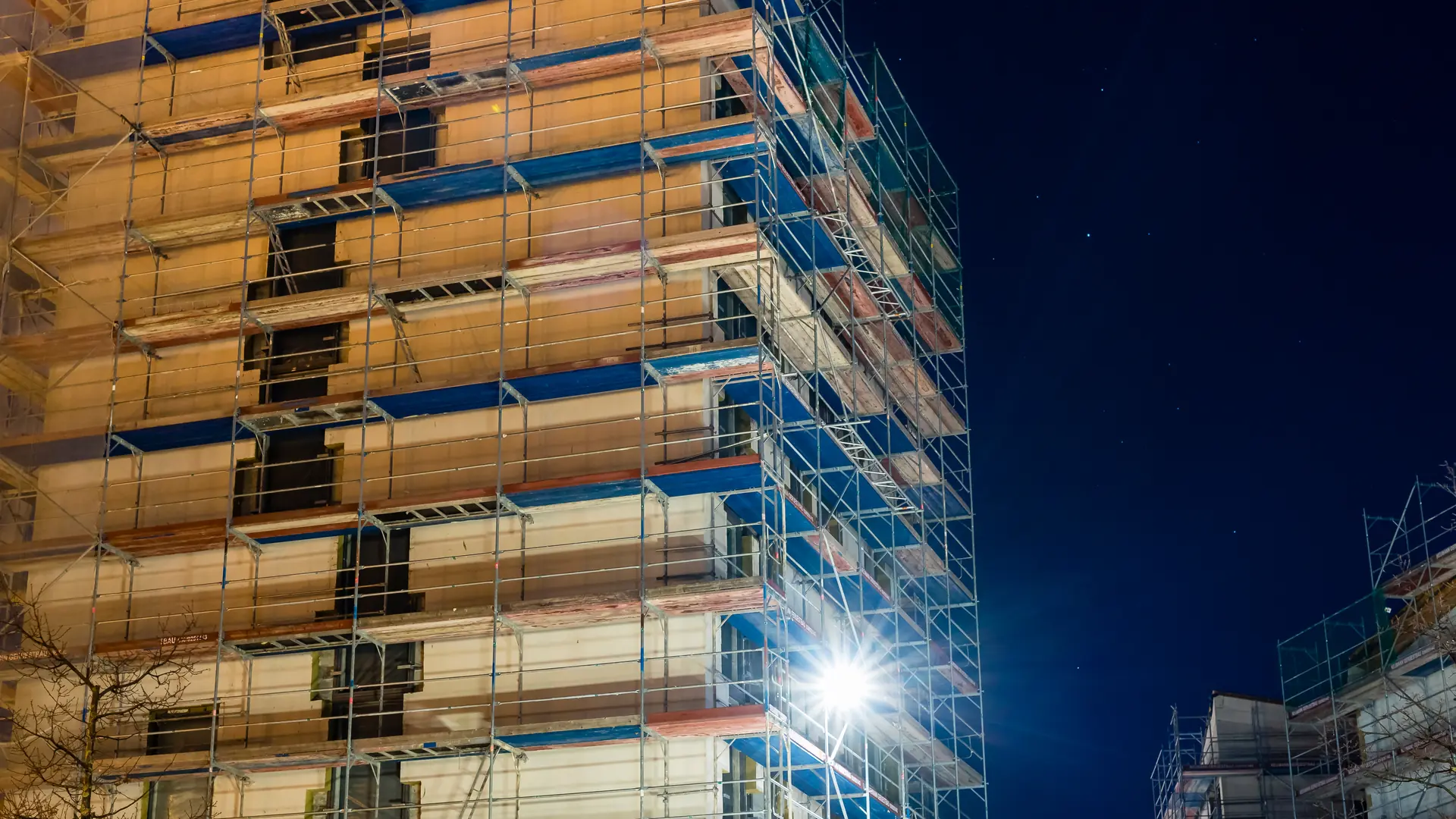
Temporary roofs to keep the weather out
Take a roof off in this country and you are gambling on the forecast. A temporary roof removes the gamble. Aluminium beams span the building off the scaffold, a covering goes over the top, and the trades below carry on in the dry while the permanent roof is stripped and rebuilt.
Weather cover
We have built temporary roofs on full roof renewals at Portman Square in Mayfair, a roof replacement in Belgravia, a complete cover at Donovan Avenue in Muswell Hill, and a tin roof over a loft extension in Bow. Domestic loft conversion or a listed block in W1, the principle is the same.
What you get
- Scaffold-supported beams spanning the full building
- Sheeted or corrugated tin roof coverings
- Designed structure with drawings and calculations
- Wind and snow loading accounted for
- Gable ends closed in and sheeted
- Full scaffold, temporary roof and debris netting
The detail
How we approach temporary roofs to keep the weather out
Beams spanning the building
The roof itself is carried on aluminium beams that span from one side of the scaffold to the other, so nothing lands on the building below. The scaffold takes the load down to the ground, which means the elevations have to be built to suit the span and the beam spacing from the start. It is not something you bolt on afterwards.
Sheeted or tin covered
Two common coverings. Reinforced sheeting over the beams is lighter and quicker, and suits shorter programmes. Corrugated tin is heavier duty, stands up to a winter and copes better on an exposed or long-running site. We will recommend one based on how long the cover is up, what is going on beneath it and what the building can take.
Wind loading and design
A temporary roof is a sail. Sheet a building over and the whole scaffold picks up wind load it was never carrying before, which is why these are always designed structures rather than something worked out on site. Drawings, calculations and a tie schedule come first, and the scaffold gets extra ties and bracing to suit. Then it is inspected before use and every seven days after.
FAQs
Questions about temporary roofs to keep the weather out
That is the job. The cover extends past the walls, the gable ends get sheeted in and we detail the edges so water runs off clear of the building rather than into it. Occupied properties, listed buildings and blocks where residents are still living in them are exactly where this matters most.
If the roof covering is coming off and the building will be open, you need a temporary roof. Sheeting the sides only stops driving rain hitting the walls — it does nothing about what falls straight down. For patch repairs, a small area of work or a roof that stays largely intact, sheeting alone may do.
Related services
You might also need
Scaffolding for roofing work
Safe roof access for full re-roofs, leak chasing, tile repairs and dormers, built to the roofer's programme.
Read moreDesigned scaffolds and engineered scaffolding
Bespoke scaffold designs with drawings and calculations for work that falls outside TG20.
Read moreLoft conversion and extension scaffolding
Full-height access for lofts, dormers and extensions, bridged over conservatories where needed.
Read moreNeed a price? We'll come and look at the job.
Free site visit, free written quotation and no obligation. Tell us what you're building and we'll tell you what the scaffold needs to do.